A few weeks ago, this tweet set off a firestorm on Twitter/X:
JUST IN: 🇺🇸 US boomers overwhelmingly support higher taxes on younger workers to maintain current Social Security benefits, poll shows.
After the usual boomer bashing, the conversation quickly turned to a question I often get from younger readers: Can I count on Social Security in retirement?
It’s a fair question. If you’re in your 20s, 30s, or 40s, you’ve probably spent most of your life hearing about how Social Security is going bankrupt. You’ve been told that the trust fund is running dry. While technically true, does it mean that you should plan as if Social Security won’t exist?
Not exactly. While the retirement trust fund is projected to run out in 2032, according to the 2026 Trustees Report, benefits will still be paid out, just at a lower percentage.
How much lower? 78% of scheduled benefits. That’s a 22% reduction, which is real. But it’s not a 100% reduction!
The average Social Security benefit today is around $2,000/month. So, if the trust fund were to run out tomorrow, the average benefit would be around $1,560/month [78% of $2,000]. That’s not great, but it demonstrates that something will continue to be paid even in such an undesirable scenario.
Given this, the question isn’t whether Social Security will exist in the future (it will), but how much of it can you count on when you hit retirement?
Let’s take a look at the numbers.
What Happens After the Social Security Trust Fund Runs Out of Money?
Social Security benefits are paid out from two sources: taxes on existing workers (i.e., payroll taxes) and the trust fund.
Well, technically, there are two trust funds. The main one is Old-Age and Survivors Insurance (OASI), which pays retirement and survivor benefits. And the other is Disability Insurance (DI), which pays disability benefits. The DI fund is in good shape, projected to pay full benefits through the end of the 75-year projection window in 2100. But OASI isn’t. That’s the one estimated to run dry in 2032.
While these two funds are often quoted together as OASDI, money can’t move between them without Congress passing a law. Let’s assume that doesn’t happen, so OASI is what we will focus on for retirement benefits.
And OASI has been running out of money since 2021. That was the first year where benefits paid to retirees exceeded the total payroll taxes collected from workers plus interest income on OASI. As a result, principal had to be withdrawn from the OASI trust fund. This will continue until the trust fund runs out in 2032.
What happens then? Since Social Security can’t borrow funds, it can only pay out what it takes in. So once the trust fund is empty, benefits would have to be brought down to whatever payroll taxes can cover.
Right now that estimate is 78% of scheduled benefits in the first year. After that, the percentage declines as the ratio of workers to retirees continues to fall. By 2100, 62% of scheduled benefits are estimated to be paid. Of course, no one knows how this will play out in reality, but that’s what the math says.
So, if you’re only going to get 78% of your benefits, your next question is likely to be: how do I calculate my benefits in the first place?
How Your Social Security Benefit is Actually Calculated
Many people assume that Social Security benefits work like a pension, where more years worked leads to a bigger payoff. This is true if you hold income constant, but that’s not exactly how benefits are calculated. The actual calculation follows three steps:
- Index your earnings. The Social Security Administration (SSA) takes every year you worked and adjusts your earnings for national wage growth. For example, during my first year of work (in 2012) I earned $36,813. But wages have grown by 57.6% through 2024, according to the SSA’s latest average wage index (AWI) table. I calculated the 57.6% by dividing the 2024 AWI by the 2012 AWI [69,846.57/44,321.67]. Note that you don’t index to the latest year, but the year you turn 60. Since I was born in 1989, my AWI index year is 2049 (which hasn’t happened yet). Therefore, I’m using 2024 for simplification. Given this, my 2012 indexed earnings would be $58,017 [$36,813 * 1.576] in 2024. If I did this exercise for 2013, 2014, etc. all the way through 2024, I’d have my yearly indexed earnings. Note that if you earned above the maximum taxable income in a given year (e.g., $184,500 in 2026) only your earnings up to the maximum count. So if I had earned $200,000 in 2012, I would have only been able to index the first $110,100 of earnings for that year.
- Average your 35 highest years. Once you have your annual indexed earnings, you sum them all up and then divide by 420, the number of months in 35 years. This creates what is called your Average Indexed Monthly Earnings (AIME). It doesn’t matter if you worked 10 years or 35 years, you still sum and divide by 420 to get your AIME. So someone who earned the maximum taxable wage ($184,500) for 10 years and someone who earned half of the maximum taxable wage ($92,250) for 20 years will have the same AIME at the end: $4,392.86 [$1,845,000/420].
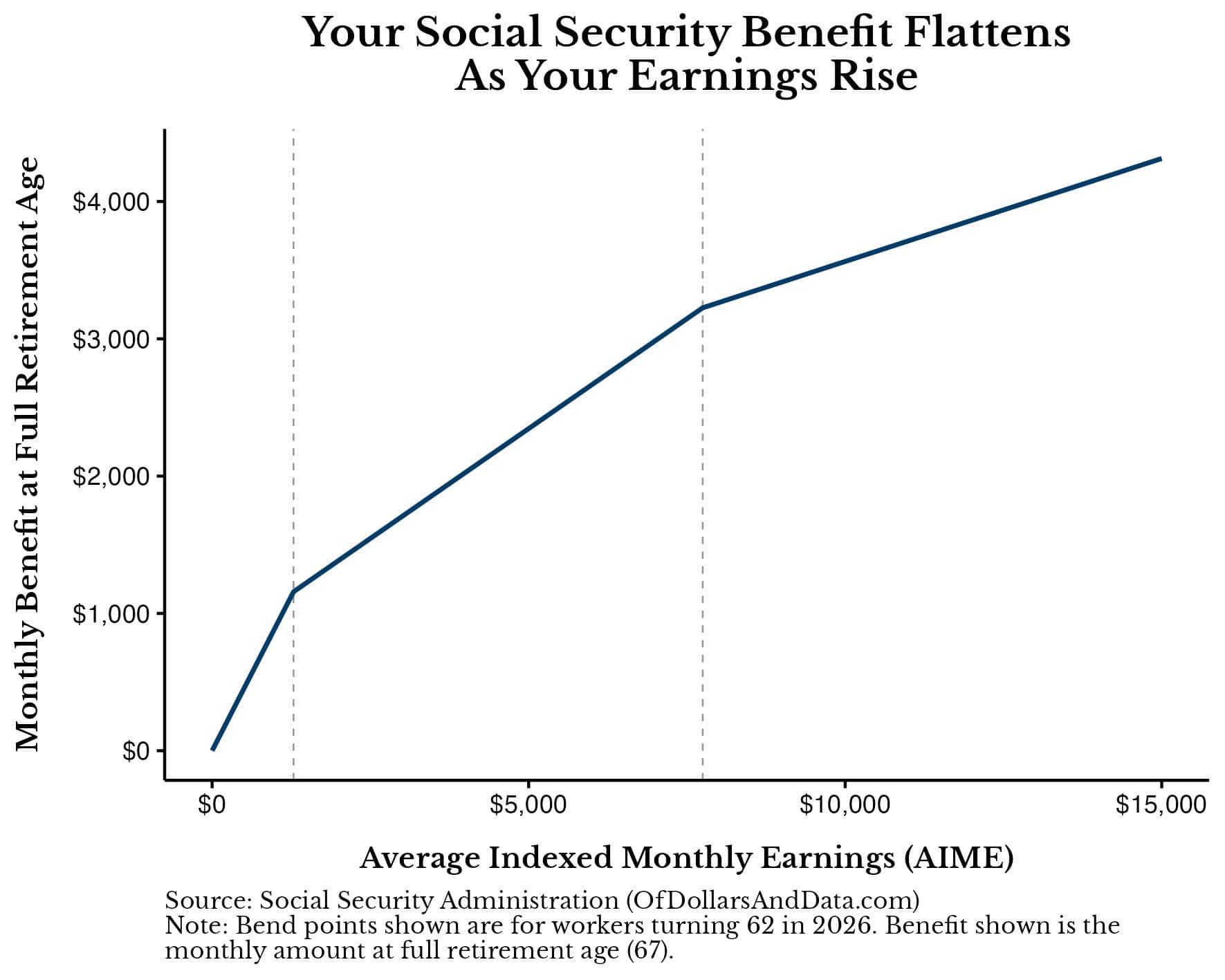
- Run it through the SSA bend points. Finally, once you have your AIME, you apply it to the SSA’s income bend points (see below). For someone turning 62 in 2026, those bend points are:
- 90% of your first $1,286
- 32% of the amount between $1,286-$7,749
- 15% of the amount above $7,749
These bend points act like a marginal tax rate in reverse. So instead of paying 90% of your first $1,286 as a tax, you earn 90% of your first $1,286 back as a monthly benefit. You then earn 32% back of every dollar above $1,286 to $7,749, and only 15% on every dollar above $7,749. These percentages correspond to the slopes of the lines at each bend point in the chart below (with the $1,286 and $7,749 bend points highlighted with dotted lines):
This progressive formula ensures that low income workers get most of their income back in retirement, but higher income workers get back a much smaller share as a benefit. You can see this in the chart below, which shows your Social Security benefit as a percentage of your AIME:
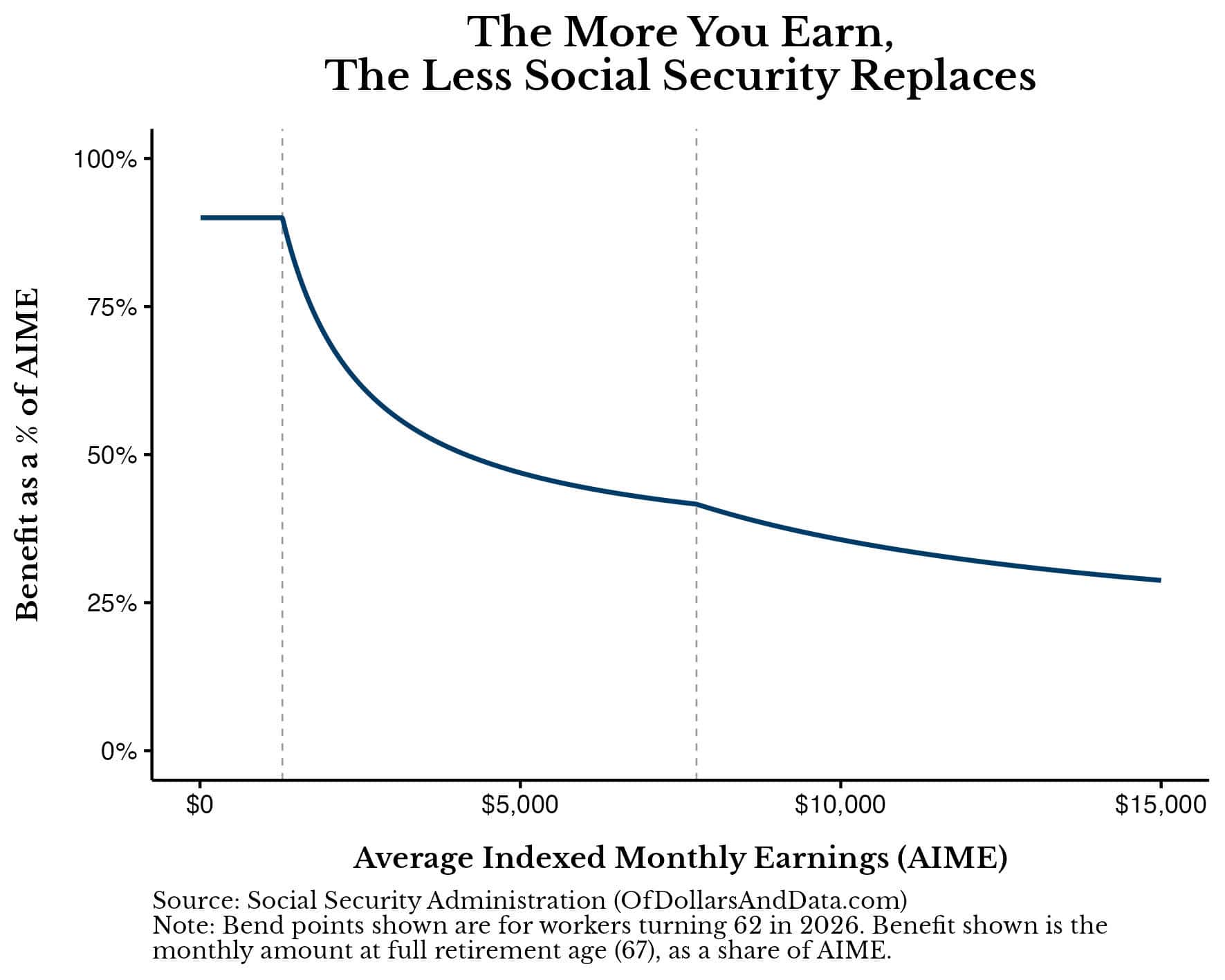
Note that if you claimed at 62, you’d get about 30% less than $2,345 (or $1,642/month). And if you claimed later at 70, you’d get about 24% more than this (or $2,908/month). This demonstrates the variation in Social Security income based on when you choose to claim it.
You can try to calculate your approximate Social Security benefits manually or put your annual earnings into the SSA’s online calculator, but this is quite a chore. Instead, I recommend using my Social Security to see your earnings history and estimated scheduled benefits in retirement.
This will show your estimated monthly benefit if you claim at your full retirement age (currently 67), early (age 62), or delayed (age 70). For example, my estimate is below (with the amounts blacked out):
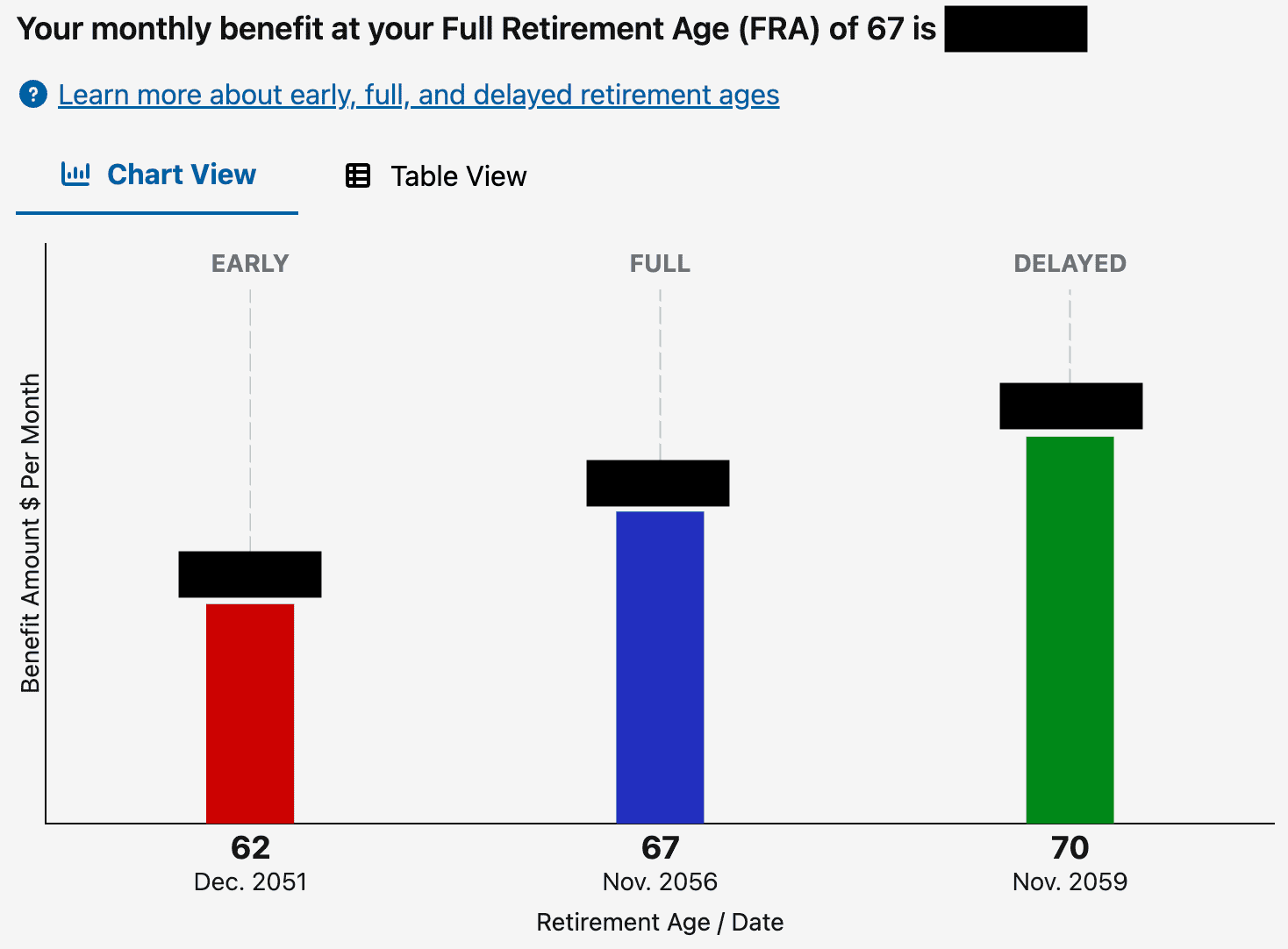
If OASI remains funded indefinitely (due to an act of Congress), you would get 100% of the listed benefit. If not, it could be 78% of the amount (or lower).
How much should you expect as a benefit? For context, the highest monthly Social Security benefit is $5,181. This applies to those who earned at or above the taxable maximum for 35+ years, waited until 70, and retired in 2026. This is higher than the average benefit of around $2,000/month, but that gives you a range.
As you can see, there is a maximum that Social Security will pay out, which is based on the maximum that can be paid in (via the maximum taxable earnings limit). But with where OASI is headed, some policymakers have argued that we should raise this limit to close the shortfall.
How Can We Fix Social Security?
When it comes to “fixing” Social Security, there are two main levers to choose from—raise revenue or reduce benefits. These are broken down into the following provisions, which are on the SSA website and summarized in this 2025 report. Note that these percentages are calculated against the 2025 shortfall. Since the 2026 shortfall is larger, each provision mentioned below will close somewhat less than what’s mentioned here.
- Revenue Provisions
- Raise payroll tax. Increase the current payroll tax from 12.4% to a higher percentage. For example, if the payroll tax were increased to 16.4%, this would eliminate over 100% of the shortfall in OASDI (see E1.1 on p. 23).
- Eliminate the taxable income cap. If the taxable income cap ($184,500 in 2026) were removed, this would eliminate 67% of the shortfall (assuming no change in scheduled benefits), or 48% of the shortfall if benefit credit for these higher earnings were allowed (see E2.1 on p. 23).
- Tax all earnings above a certain amount. Instead of eliminating the taxable income cap and taxing every dollar earned above $184,500, this would only start taxing earnings above a specific income like $400,000. So, if you earned $500,000, you’d pay 12.4% on the first $184,500 of earnings, then nothing until $400,000, then an additional 12.4% on the $100,000 you earned above $400,000. This proposal would eliminate 58% of the shortfall (see E2.13 on p. 24).
- Benefits Provisions
- Raise the retirement age. For example, if the full retirement age were gradually raised to 68 (starting in 2026), this would eliminate 12% of the shortfall (see C1.1 on p.17).
- Index the bend points to prices instead of wages. Currently the SSA income bend points for determining benefits are indexed to wages, not prices. Since wages tend to grow faster than prices, this keeps benefits rising in line with the broader economy. However, if we were to index the bend points to prices, instead of wages, the amount of income they replace from your working years would decline. Historically, Social Security has replaced around 40% of working wages for a median earner. If this provision were adopted, that share would gradually be cut in half, which is why it would eliminate 74% of the shortfall (see B1.1 on p. 6).
- Reduce the Cost of Living Adjustment (COLA). Once you start drawing on Social Security, it is adjusted annually for the cost of living. One provision is to reduce this COLA by one percentage point. If adopted, this would eliminate 51% of the shortfall (see A1 on p. 4).
There are other provisions beyond these, but these cover the main ideas. To fix Social Security, Congress either needs to raise more revenue from existing workers, reduce the benefits being paid out to current (and future) retirees, or some combination of the two.
While a combination is possible, public support suggests that Congress is more likely to raise taxes than cut benefits. According to a 2025 survey from the National Academy of Social Insurance, 85% of respondents said benefits should be maintained or increased, even if it means raising taxes on some or all Americans. And given that the only provision listed here that closes the entire shortfall on its own is raising the payroll tax to 16.4%, I’d lean toward a world of higher taxes than a world of lower Social Security income.
Now that we know that Social Security can still pay out most benefits and that fixing it requires some serious tradeoffs, does this mean you can count on it for your retirement?
So, Can You Count on Social Security?
Despite what fear-mongering headlines may suggest, you are very likely to receive the majority of your Social Security benefit in retirement. Even if OASI runs out in 2032, ongoing payroll taxes will be able to pay out around 78% of scheduled benefits in the first year. Of course, I don’t think that will happen. I believe Congress will act to either raise revenue or reduce benefits to mitigate this to some degree.
Whether they cut benefits or OASI runs out, you should still receive 70% of your scheduled benefits. That’s a reasonable estimate and one I assume in my retirement planning.
For the average person retiring in 2032, this would equate to around $1,400 a month [$2,000 average benefit * 70%]. If you are retiring later, this amount is likely to be more (even after accounting for future inflation). Why?
Because wages tend to grow faster than prices. So your AIME should outpace price inflation over time and your benefits should be larger than what they would be today.
The best thing you can do is go to the SSA’s my Social Security, find your current estimated monthly benefit, and multiply it by 0.7. So if it says $3,000/month, your planning estimate would be $2,100/month.
And if you know that you’ll need about $8,000/month in retirement, then you only need to cover the remaining $5,900/month [$8,000 – $2,100]. Multiply $5,900 by 12 and you have annual spend (above Social Security) of $70,800. Multiply $70,800 by 25 (the 4% Rule) and you get $1.77M. That’s roughly how much you need in addition to your Social Security benefit to fund your retirement.
Of course, this is making a lot of assumptions. In reality, nothing is guaranteed. Congress could pass a law tomorrow ending Social Security entirely. They could raid the trust fund next year to increase their personal salaries. They could do lots of drastic things, but I don’t think they will.
While I wouldn’t plan my retirement around my Social Security check, assuming it won’t be there is the bigger mistake.
Thank you for reading.
If you liked this post, consider signing up for my newsletter.
This is post 526. Any code I have related to this post can be found here with the same numbering: https://github.com/nmaggiulli/of-dollars-and-data