My late grandfather gambled away over $1 million during his lifetime. His wager of choice was horse racing. But if he were alive today, I’m confident he’d be into sports betting. How do I know? Because most other gamblers are.
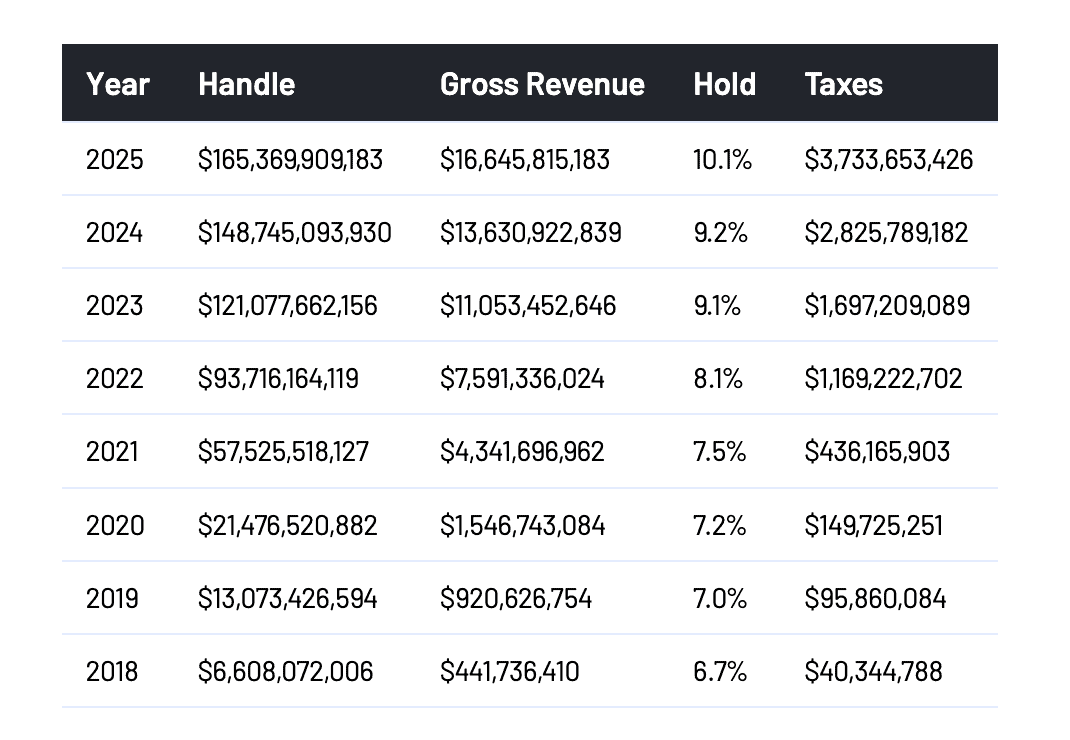
Today, 52% of men aged 18-49 have an online sportsbook account, up from 39% in 2024. That’s over half of all U.S. men this age, not just gamblers. But what really makes this striking is how much they are betting. From 2018 to 2025, the total handle (amount wagered) on U.S. sportsbooks went from $6.6B to $165B, a 25x increase within 7 years.
How did this happen? In May 2018, the Supreme Court overturned a law banning sports betting across the United States. The court held that the decision was not up to Congress and the federal government, but up to the states. As a result, 39 states plus Washington, D.C. now have legal sports betting.
And as access and volume have grown, so has the house’s cut of each dollar. As you can see in the table below, hold (how much sportsbooks keep per dollar wagered) has steadily climbed from 6.7% to 10.1% over this time period:
How did sportsbooks manage to increase their hold so much? By promoting parlays, or bets where multiple outcomes need to occur for you to win. One of the most popular ways to do this is a same game parlay (SGP). For example, instead of betting on the NY Knicks to win (a single bet), I could do an SGP where:
- The Knicks win
- Jalen Brunson scores over 30 points, and
- The final game score exceeds 200 points
If all three of those things happen, I win the bet, if not, I don’t.
These parlays are better for sportsbooks because they tend to pay out less than the true odds would suggest. And when you pay out a little less across multiple bets, the house edge shoots up. As Chad Nagel at Sportsboom reported, the house edge for SGPs is 20% to 35%, compared with 4.5% for a standard point-spread bet. And, as SGPs have become a larger share of sportsbook revenue (from under 20% in 2021 to 35%-40% today), the average hold has increased along with them.
Given these recent developments, you’d think the sportsbooks would be pretty happy. But they aren’t. Because they have competitors who have found a loophole—prediction markets. Companies like Polymarket and Kalshi, which started as prediction markets, now offer event contracts for sports. It’s sports betting by another name.
However, there are a few big differences between sports betting on prediction markets and on sportsbooks. First, prediction markets are regulated by the CFTC, not the states, meaning they don’t have to pay the state gaming taxes that sportsbooks do.
Second, prediction markets don’t have the same age restrictions as sportsbooks. So 18-to-20-year-olds can place “predictions” on Kalshi though they have to be 21 to place bets on DraftKings or FanDuel. Lastly, many states have self-exclusion lists, where individuals struggling with gambling can voluntarily ban themselves from placing bets. Sportsbooks have to honor these lists imposed by states, but prediction markets aren’t required to.
There’s a cruel irony to how this has all played out too. Sports betting was able to escape federal law with the May 2018 Supreme Court ruling. And now prediction markets are able to escape state law since they are regulated by the CFTC. So adults under the age of 21 in many states (even some states where sportsbooks are banned) can now legally bet on sports via prediction markets.
And this is exactly what is happening. Pew Research found that sports event contracts make up 80% of trading on Kalshi and 39% on Polymarket since July 2024. Sports contracts aren’t a fringe thing on these prediction markets either. They’re becoming the core business model. For example, after Kalshi launched its own version of SGPs (“combos”) in September 2025, shares of DraftKings and Flutter (FanDuel’s parent company) both fell by double digits.
Putting it all together, prediction markets are poised to profit, free of state gaming regulation, from the very population that’s most susceptible to gambling addiction—young men. And, yes, it’s undeniably young men with the most gambling issues. One meta-analysis across more than 150,000 participants found that men were 3.4 times more likely than women to engage in problem gambling, and adults under 35 were 1.5 times more likely than middle-aged adults to do the same.
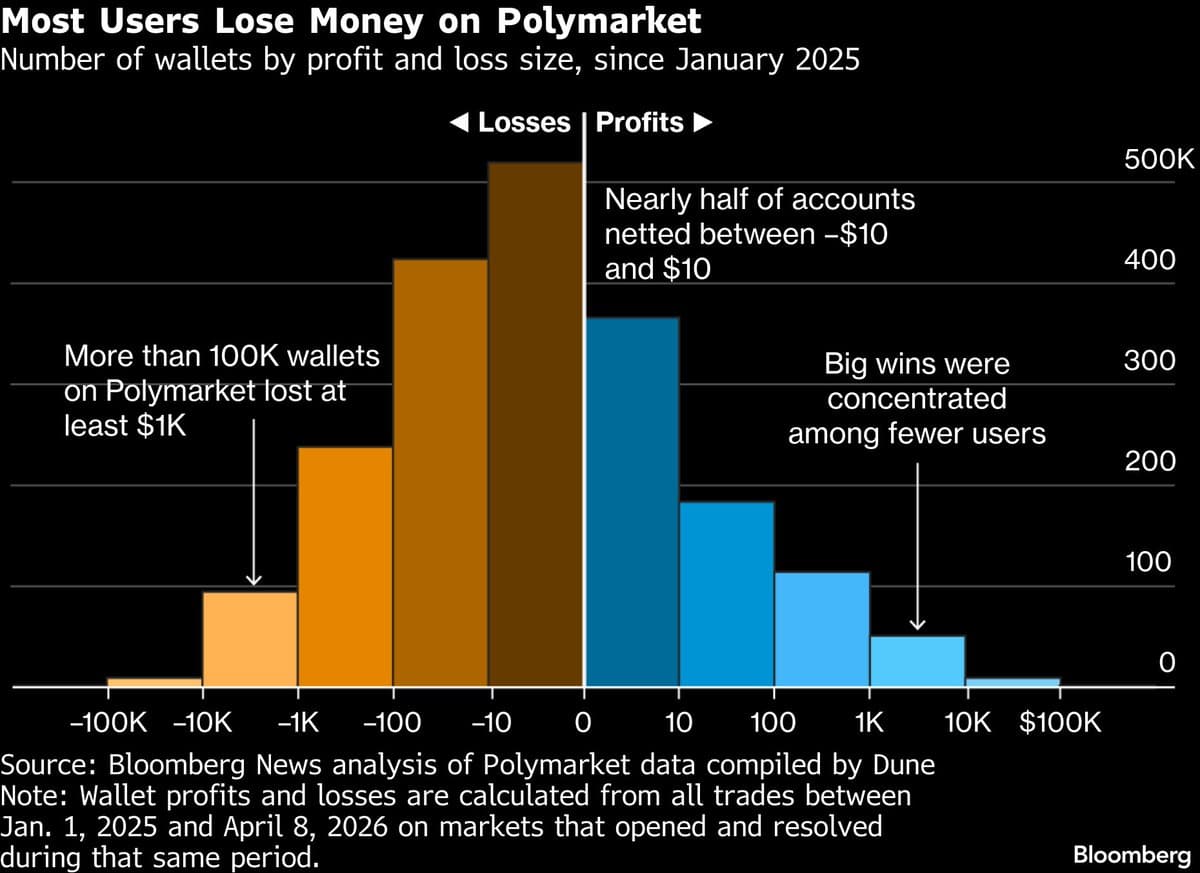
All of this will have dire consequences for thousands of men across the United States. And I don’t just mean financial consequences either. You already know that most people lose money on these platforms. This tweet from Denitsa Tsekova showing the distribution of wins and losses on Polymarket (from January 2025 to April 2026) illustrates it clearly enough:
But what you may not know is all the other things they can lose as well.
I’m not trying to be dramatic. I understand that most people who gamble do it for fun. They treat it as a form of entertainment with a known cost.
Unfortunately, this isn’t true for everyone. For people like my grandfather, such “entertainment” can have unknown costs as well. Because though he gambled away over $1 million, his biggest loss wasn’t his money…it was his wife and his family.
He got divorced while my father was still a teenager and eventually moved back in with his mother. Though we visited him from time to time when I was young, he spent far more time chasing horses or playing cards than with us. There’s more to that story, but I’m not going to tell it.
I think about what happened to my grandfather because similar stories will play out across the country in the coming years. Some men will get caught in a destructive cycle that will ruin their lives. Researchers have already shown how the legalization of sports betting leads to increased bankruptcies and more domestic violence following upset losses. There are real families behind these statistics, and real men who will be left broken as a result.
Yes, this is partly their doing. They chose to gamble after all. But the industry is doing little to slow them down. If anything, sportsbooks and prediction markets are making it easier to gamble than ever before. My grandfather at least had to drive to the track to feed his addiction. Today’s gamblers need only reach for their phones.
Of course, the CEOs of these companies will talk about how much they try to help compulsive gamblers. Yet they know exactly what they’re doing to encourage them further. Consider this tweet from the CEO of Kalshi, pitching a longshot as a way to build wealth:
90 minutes left to attempt generational wealth.
The odds are not zero. And it’s free.
You owe it to your grandchildren.
I know sports betting and prediction markets can seem like fun and games, but you can lose a lot more than just money. Your grandchildren won’t forget it either.
Thank you for reading.
If you liked this post, consider signing up for my newsletter.
This is post 528. Any code I have related to this post can be found here with the same numbering: https://github.com/nmaggiulli/of-dollars-and-data